Volleyball Toolbox

  • Home
  • Drills
  • Systems
  • Sports Performance
  • Practice Planning
  • Intangibles
    • Leadership
    • Mental Skills
    • Team Building
  • Shop
  • Archives

R.E.A.L. Man (and Woman) Program

February 14, 2019 by

The R.E.A.L. Man Program is a strategic and progressive character development program designed to help middle school, high school, and college-aged students to reach their full potential, in every aspect of their lives.

The 20-lesson program is a blueprint for success, which is aimed at helping students understand and live out the principles of a positive and influential life.

The foundation for the program can be described as:

Respect all people,
Especially women.
Always do the right thing.
Live a life that matters.

Here are a three videos about the R.E.A.L. Man Program.

The first video is a short description of the program. The second video is of an actual lesson taught by a coach at a school that utilizes the R.E.A.L Man Program. The third is an overview of the program.

The second video is a YouTube video, so you will need to be on a server that allows you to access YouTube.

There is sound with each video.

If you are interested in finding out more about the program, contact:

Kathy DiCocco at 203-206-4801 or email her at [email protected]

Or click here to visit The R.E.A.L Man Program

Please click the play arrows to view the videos.

R.E.A.L. Man Overview
https://coachingtoolbox.net/wp-content/uploads/2019/02/jamesvint.mp4


Learning to do the Right Thing

James Vint on the R.E.A.L. Man Program

https://footballtoolbox.net/wp-content/uploads/2019/02/Overview-of-The-R.E.A.L.-Man-Program.mp4

Filed Under: Leadership

So What is Leadership

June 30, 2018 by

This article is also posted  on The Coaches Toolbox, a collection of free resources for coaches of all sports

Answering the question “What is leadership?” begins by grounding it in these 7 core assumptions

By Dr. Cory Dobbs
The Academy for Sport Leadership

Excerpt from A Leader in Every Locker (2016)

“I’m not used to supposing. I’m just a working man. My boss does the supposing . . .”

This quote is a line from the classic movie 12 Angry Men. During the opening dialogue among jury members, each feeling out their place and role in the deliberation of the fate of a young man’s life, a blue‐collar working man makes this declaration of powerlessness. The implication is that all the power—at least that of “supposing” rests in the hands of his superior. Just a movie? Hardly.

It’s been the rule for over a century in team sports to install a hierarchical leadership structure. This is accomplished by appointing a couple of players as team captains (as well as modeled by the hierarchy of the coaching staff). Surely everybody knows that on any sports team only a few players are able to really perform peer leadership. This is the team captain axiom, the basic axiom of traditional team leadership.

An axiom, of course, is a truth so self‐evident it doesn’t need to be proved. After all, everybody knows an axiom is accurate and correct. So then, it’s indisputable that you need a pecking order in order to get things done.

Not too fast, things are not what they always seem to be on the surface. The bad news is that far too often our intuitive ways of thinking about the world are wrong. Yes, axioms can be wrong. The good news is that it’s possible to set them right.

What’s self‐evident, what’s obvious, what everybody knows, has deep roots and of course isn’t in need of change. Yet, paradoxically that which is self‐evident hides something–covers over what might be a deeper truth. Axioms, by their nature, are anti‐learning. Nobody ever questions an axiom. Nobody ever discusses an axiom (save for a few propeller heads). It’s just taken as a given. And nobody ever talks about the possible counterproductive consequences of what everybody knows. The fish, after all, never questions the water he lives in.

Then, all of a sudden, someone comes along with a breakthrough idea and turns the old axiom upside down. The taken‐for‐granted truth, it turns out, wasn’t really the truth after all. “The world is flat,” was the truth people lived by for thousands of years. Then, along comes Nicolas Copernicus who proves to the world the old axiom to be wrong.

Twenty years ago, to choose a different model of team leadership was unthinkable. In elaborating on the end of two decades as a premier athlete Kobe Bryant had much to say when asked the question, if he could go back in time and offer advice to himself as a rookie, what would he say? His response: “It’s hard to tell somebody ‐‐ a player at that age ‐‐ to understand compassion and empathy, but that would be my advice.”

Why of all things would Bryant endorse caring, compassion, and empathy? “Well,” Bryant continued, “because that’s the biggest thing about being a leader, I think, and winning a championship is understanding how to put yourself in other people’s shoes.” “That’s really the most important thing. It’s not necessarily the individual skill you possess. It’s about understanding others and what they may be going through. And then, in turn, when you understand that, you can communicate with them a little bit better and bring out the best in them. Bringing out the best in people isn’t passing them the ball and giving them open shots. It’s about how to connect with them, how to communicate with them so that they can navigate through whatever issues they may be facing. That’s a very, very hard thing to do.”

I’ve never been a fan of Kobe Bryant, and I seldom look to professional sports for deep insights and understanding on leadership, but it appears that the wisdom in Bryant’s words fit hand‐inglove with today’s call for a more heartfelt approach to coaching and leading. So what’s the way forward in this brave new world?

Don’t worry. While you’ve been trapped in the axiom of team captaincy, I’ve been turning over rocks to find a better way of designing a high‐performing team, its culture, and of course, leadership. I’m not done yet. It might be another decade or so before I’m finished. But this workshop workbook is a start.

So, What is Leadership?

There has been a long running debate in scholarly circles about whether people learn to lead from their experiences or if leadership is something a person is born with. Today, however, most academics agree that leadership is best considered as a set of skills and qualities that can be learned and developed along within a wide‐range of personal styles. It’s widely agreed that all people have the potential to develop leadership skills. I point this out because it is also clear that leadership is viewed and valued differently by various fields, disciplines, and cultures.

So then, what is leadership? This is the big question that every person, group, team, organization, community and society seeks to answer. Our American culture, which of course includes a heavy dose of sporting influence, exalts the lone ranger, the hero, the charismatic leader. We see this in the election and glorifying of politicians, the deifying of business tycoons, and the adoration and idolization of great coaches and athletes. This notion falls in line with the traditional ideas of leadership—that it is the make‐ up of the leader that makes all the difference. Individual determinism has been and will continue to be an easy and favored explanation of things. But traits such as self‐confidence, intelligence, and a can‐do attitude—favored qualities of a leader—do not always predict the effectiveness of a leader; rather, they can be very misleading.

However permeable the traditional mental model of leadership seems, it does not provide a path to sustainable effectiveness as it leaves out the detail and nuance of the context in which a leader takes action. It also ignores the fact that it tends to reduce followers to passive participants; resulting in deliberate apathy and often conscious withdrawal from the leadership provided by one’s peer. Careful examination of this aspect of team captaincy suggests it may promote the discounting or dismissing of the potential of all members of the team to learn and perform in a leadership role.

Both the context and followers are foundational to leadership and are central to The Academy for Sport Leadership’s search for a new conceptualization of team leadership. The leader in every locker approach to team leadership is, no doubt, a paradigm shift. Paradigms, as you know, are the common patterns and ways of looking at things in order to make sense out of them. Leadership has long been presented as an elusive phenomenon available to only a select few. It is my contention, however, that understanding the relational nature of leadership and followership opens a team up to an immensely practical and dramatically richer form of team
member involvement.

The basic foundation of any leadership process is relational. As leadership expert Margaret Wheatley notes, “None of us exists independent of our relationships with others.” At the core, it is a relationship which comes into existence because of some sense of commitment by people to a common purpose. Thus, the ASL framework for answering the question “What is leadership?” begins by grounding it in the following core assumptions:

1. Conventional views of leadership are changing. Leadership is not limited to a chosen few; it is an educational component of participation in student‐athletics and must contribute to the growth and development of all athletes. A leader in every locker embraces the potential of all student‐athletes to take on leadership roles now and in the future.

2. Leadership is a relational process. That is, leadership is a socially constructed phenomenon consisting of student‐athletes working together to accomplish something.

3. Team leadership is distributed. Leadership is not the sole responsibility of the coach, coaching staff, or selected team captains. The best team leadership results from the actions and activities of those best positioned to provide leadership contingent on the context.

4. Leadership is a process to create change. Leadership is about making things happen; transforming people and programs. Effective leadership accelerates change. Change is necessary for growth, development, and improvement in performance.

5. Leadership growth and development is personal. There is no time frame related to progressing through stages of development. It’s also recognized that all potential leaders begin at a different starting point. Leaders grow and develop through deliberate practice, informal practice, roles, reflection, and the observation of role models.

6. Leadership is a process that involves followership. All coaches and student‐athletes participating in a leader in every locker understand and embrace both roles—leading and following. Followership implies a relationship to the leader, but does not imply one that places the follower in a less important position.

7. Leadership develops over time. There is no one way to lead. The practice of leadership involves the continual practice of finding the best way to lead with the particular capabilities that the student‐athlete possesses at a specific time, while constantly working to improve and expand those capabilities.


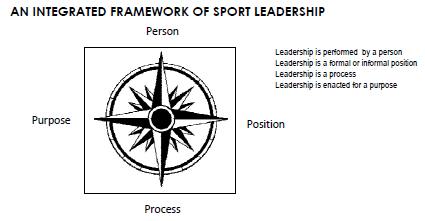
Embedded in the seven assumptions above are the four P’s of team leadership. The framework highlights the integration of the four key domains of leadership. The framework answers the question What is Leadership? Leadership is a position, it is a process, and it is performed by a person for a purpose.

Too often leadership is narrowly defined exclusively as a person. Conceptually this leads us back to a focus on the leader, her traits and disposition. But leadership is more than the idiosyncratic actions taken by a chosen person. It is a process. A process is simply a
coordinated way of doing things. Can student‐athletes, including those that don’t possess the so‐called necessary traits, learn a process for doing leadership things? Of course they can.

Leadership is also a position. In The Academy for Sport Leadership’s way of doing things we suggest giving each student‐athlete a “role” to on‐board them into the leadership team building development process. You’ll see this later when I introduce you to my 8 Roles of Teamwork. A leader’s words and deeds provide purpose, a compelling vision of the future. Effective team leadership answers, for all team members, the questions, “why am I doing this?”

The four P’s, like the compass that they form, are only a tool for answering the question “What is leadership.” Each student‐athlete (and coach too) brings his or her own unique values, skills, experiences, and personality to the leader role; and each student‐athlete has his or her own personal way of making change happen. The compass is a simple model that represents the key domains of an effective leadership development program.

To find out more about and order Sport Leadership Books authored by Dr. Dobbs including Coaching for Leadership, click this link: The Academy for Sport Leadership Books

If you would like to learn more about the book that this excerpt came from click: A Leader in Every Locker


Filed Under: Leadership

Turning the Ship Around

June 3, 2018 by

This article can be found at The Coaches Toolbox, a collection of free resources for coaches of all sports.

By Cory Dobbs, Ed.D.

A maxim of team building is that the biggest wins start small.  This too is true of the biggest losses.  Recently, I was called in by a successful coach to help him save his season from becoming a complete disaster.  At the time of the call the team was five and fifteen.  And four of the five wins came from beating perennial losers. Essentially this team won only one competitive match.

No matter how hard you try it takes the greater part of a season to pull together a group of young student-athletes. Cohesion is never a given.  Unfortunately for the distressed coach who called me for help, the pulling together had yet to take place.  Rather, bit-by-bit the players built relationships that pushed them apart, a gap emerged from player to player.  Conflict avoidance and superficial harmony were the unwritten rules of relationship building.  The result was a downward relational spiral in which morale deteriorated gradually at first, then a tsunami of ill-will permeated interpersonal interactions.

Finally, the team woke up and realized that there was no sense of unity or authentic camaraderie on the team, which translated into a team of selfish and uncommitted players.  Luckily for the coach, most of the players admitted fault (as did the coach) and willingly accepted working side-by-side with the coach to create an engaging and inspiring environment.

Over the years I’ve come face-to-face with the reality that something big always comes from something small.  Small causes are so often the start of something big—both on the positive and negative side of the ledger.  Yet too often we only attend to something after it has already become a hefty problem requiring a massive undertaking.

For the coach and the player to recover the season they realized change was necessary for survival.  The time had come for all team members, coaches included, to shed the illusion that they were building right relationships that would take them where they wanted to go.

COURSE CORRECTION

To inspire the team to quickly adopt changes—those the players proposed and others put forward by the coaching staff—they decided to look to Hollywood.  Yes, tinsel town!

Screen writers tell us that there is really only seven or so master plots from which all stories are developed.  These story structures are called archetypes.  An archetype offers the audience a relatable back-story with a familiar pattern that taps into the mental models of the viewer.  The classic archetypes include: rags to riches, overcoming adversity, the quest, comedy, tragedy, voyage and return, and rebirth.

The idea was for the team’s members to create a story that they wanted to “write.”  All participants agreed that to transform the team required a story that would fit the team today and acknowledge its current realities.  The goal was for the team to agree to adopt, enact, and live the story daily.  The team agreed to undertake the challenge of change by employing the archetype of Disastrous Voyage and Fortunate Return.  This was fitting because this archetype is about progression from naivete to wisdom, from disparity to triumph.  In typical Hollywood movies the protagonist stumbles across obstacles and challenges with the mistaken notion that they know where they are going.  In this real-life voyage the players sadly were heading in the wrong direction to creating a competitive team with a sense of well-being for its participants.

Beginning with the team’s current realities it seemed fitting to “title” the change story Turning the Ship Around.  The student-athletes discussed together their story with candor and enthusiasm—how they got to where they were and how they wanted to go about changing their course.  By agreeing to the archetype they went about living a shape-shifting story of resurgence and resurrection based on building durable and enduring relationships.

Fortunately, the path to turning the season (the ship if you will) around began with small victories.  Not victories on the playing field, rather small wins in building right relationships.  Day-by-day living the narrative of Turning the Ship Aroundthe team did come to experience a successful change of course.  After one more loss the dedicated team lived to tell the tale of a seven-game win streak to finish out the season. By righting the course the team is now ready to set sail for an exceptional season next year.


To find out more about and order Sport Leadership Books authored by Dr. Dobbs including Coaching for Leadership, click this link: The Academy for Sport Leadership Books

About The Academy for Sport Leadership

The Academy for Sport Leadership is a leading educational leadership training firm that uses sound educational principles, research, and learning theories to create leadership resources.  The academy has developed a coherent leadership development framework and programs covering the cognitive, psycho-motor, emotional and social dimensions of learning, thus addressing the dimensions necessary for healthy development and growth of student-athletes.

The Academy for Sport Leadership’s underlying convictions are as follows: 1) the most important lessons of leadership are learned in real-life situations, 2) team leaders develop best through active practice, structured reflection, and feedback, 3) learning to lead is an on-going process in which guidance from a mentor coach helps facilitate learning and growth, and 4) leadership lessons learned in sport should transcend the game and assist student-athletes in developing the capacity to lead in today’s changing environment.


Filed Under: Leadership

How to Turn a Negative Culture Around

May 29, 2018 by

By Dawn Redd-Kelly

If you’re not happy with the culture of your team, how are you working daily to change it around?  As was said over at Leadership Freak, “Toxic environments are the result of neglecting culture-building and tolerating toxicity.”

When we find ourselves with a negative team culture, it’s easy to blame the athletes, but we hold some accountability as well.  We’ve both neglected the culture and tolerated the things that are counter to our beliefs.

So what now?

5 quick tips for building a culture of positivity:

  1. Encourage your athletes to express gratitude: for practices, for getting coached hard, for their teammates, etc.
  2. Find ways to honor culture builders: if you’ve got an athlete who has bought in, whether they’re a starter or bench dweller, point them out!
  3. Reward those who are on board: perhaps you can create a weekly team award for the athletes who best represent the qualities you’re trying to instill with your team.
  4. Remove the worst offenders: if you’ve worked and worked with them…sometimes they just have got to go.
  5. Show interest in your athletes as people: crazily enough, our athletes have other interests besides our sport…find out about them.

Be a culture hawk for your team!  Not only will your athletes enjoy coming to practice more each day, I’d bet your outcomes in the win/loss column will also turn from negative to positive.

Are you tired of walking into practice and seeing lackluster effort from your players?  Have you had it with trying to get your female athletes to care about the team as much as you do??

Click here to find out more about Coach Dawn’s eBook: Motivating Female Athletes

Comes with a FREE PowerPoint presentation called Guarantee Your Success: Using John Wooden’s Pyramid of Success To Increase Your Team’s Cohesion.


Filed Under: Leadership, Program Building

The Art of Leadership

May 19, 2018 by

This article is also found on the Coaches Toolbox, a collection of free resources for coaches of all sports.

The success of any institution, organization, group, or team, is grounded in the effective application of leadership.

By Cory Dobbs, Ed.D.

Lessons from the Art Studio

“Students who are truly student-athletes have a chance for a life-transforming, life-shaping experience. I can tell you how thankful I am for having had that experience and how it’s shaped me in countless ways. It’s an absolutely formative experience.” –
U.S. Secretary of Education Arne Duncan,
Speaker at the 2010 NCAA National Convention in Atlanta, Ga.

Leadership is one of the most important topics of our time. And it’s likely one of the most important attributes for effectiveness in any human endeavor. The success of any institution, organization, group, or team, is grounded in the effective application of leadership. For any organization to sustain success it must invest in the development of leaders—current and future— to avoid a regression towards mediocrity.

Since the dawn of civilization, groups have utilized leadership for various purposes beginning with the need for survival. Organizations today view leadership as a necessity for success and it is hard to find a person today who does not give at least lip service to the importance of developing leaders.

Click here

download your FREE exclusive ebook from Dr. Cory Dobbs


Yet despite this apparent intent to nurture the development of leaders, we still find ourselves desperately searching for leaders that can create and sustain success. Perhaps part of the problem is the way we teach leadership.

I teach leadership courses in two different graduate colleges for the same university. Different students, same classroom. The classroom consists of a podium, tables with chairs and a white board. The rooms are designed for teachers to stand and students to sit.

However, the classroom in which my colleague teaches art is quite different. In her art studio she often does not stand and students don’t sit. The simple reversal of classroom roles leads to a different mode of learning. Students in the art classroom poke around, observing the work of their fellow students. They ask questions, share stories, exchange insights, and offer praise or constructive critiques.

I’ve learned some powerful lessons from studying learning in the art studio. Two, of them in particular have reshaped the way I approach leadership development.

1. Anything worth doing is worth doing badly.
2. The fear of failure will guarantee failure.

Anything Worth Doing is Worth Doing Badly
Not the orthodox way of looking at excellence. However, leadership is a messy proposition for anyone learning to lead. Since leadership is a social process, it follows that team leaders will need to experiment with such things as peer accountability. Invariably, the beginning leader will stumble. Encourage your student-athletes to get going, start leading, and take the lumps that come with learning to lead.

The art studio encourages the student to explore. Taking risks—experimentation—and being willing to do leadership badly are part of the learning process. In the art studio students are encouraged when they do something badly. They quickly look at the bad product and figure out how to improve upon their work. Poor outcomes are not seen as failures. Rather, the art student returns to the canvas to try again.

To offer some real-world perspective on bad leadership as a learning opportunity, take a quick look backwards to when you took your first coaching job. Who among us can’t look back and see incompetence and failure in some leadership efforts during our formative years? I’m on pretty safe ground here knowing that all competent coaches attended Hard Knocks University.

Here’s a simple way for you to guide your student-athletes to face the fact that risk is necessary for them to fully develop as a leader. Have them set up a matrix that involves listing leadership goals on one side of the ledger with possible risks on the other.

Sample Leadership Goal

To promote team unity through a weekly players only meeting.

Risk

One or more team members do not want  to attend and see the leaders as “better than them”

Fear of Failure Will Guarantee Failure
While the artist’s palette contains a wide-array of vibrant colors, the only color emerging leaders see is gray. Nothing appears to be black and white for the beginning leader. She’s not sure where to start, what to do, how to take leadership action. Fear of failure is real.

Failure often affects confidence and self-esteem. However, failure is not fatal. Giving your leaders the license to fail is a starting point. Creating a learner-centered approach to leader development can help the novice and the experienced team leader. Artists that persevere face their fear of failure. Failure in the art studio is guaranteed. Perfection is desired, but failure is acknowledged as part of the process.

I’ve noticed far too many young leaders fearful of leaving their comfort zones, clinging to what is comfortable and secure. The art student is encouraged to venture out and explore new styles and tools. In the art studio it is folly to discount mistakes and failure.

In the art studio, students are confronted with reality. What they put on canvas is available for all to see. Sometimes the visible picture doesn’t match the artist’s heart and effort. Such moments can be both disheartening and empowering. Vulnerability is a vital part of learning to become an artist—and a team leader.

Leadership certainly can begin to be taught in a classroom. Yet conventional methods of leadership training often fail to prepare students for the messiness of leadership. The art studio provides another model to explore as a bold approach for developing your team leaders. Experimentation, exploration, and action will involve mistakes and failure. Guiding your young leaders through the risks of leadership may well be the most important role you assume as a leadership educator.


To find out more about and order Sport Leadership Books authored by Dr. Dobbs including Coaching for Leadership, click this link: The Academy for Sport Leadership Books

About the Author

A former basketball coach, Cory’s coaching background includes experience at the NCAA DII, NJCAA, and high school levels of competition. While coaching, he researched and developed the transformative Becoming a Team Leader program for student-athletes. Cory has worked with professional athletes, collegiate athletic programs and high schools teaching leadership as a part of the sports experience and education process. Cory cut his teeth as a corporate leader with Fortune 500 member, The Dial Corp. As a consultant and trainer Dr. Dobbs has worked with such organizations as American Express, Honeywell, and Avnet.

Cory has taught a variety of courses on leadership and change for the following universities:

Northern Arizona University (Graduate Schools of Business and Education)

Ohio University (Graduate School of Education / Management and Leadership in Sport)

Grand Canyon University (Sports Marketing and Sports Management in the Colangelo School of Sports Business)

Visit www.corydobbs.com to read Cory’s leadership blog.


Filed Under: Leadership

  • « Previous Page
  • 1
  • 2
  • 3
  • 4
  • 5
  • …
  • 12
  • Next Page »
  • Team Building
  • Mental Skills
  • Leadership
  • Practice Planning
  • Sports Performance
  • Systems
  • Drills
  • Archives

© Copyright 2025 Athletic Performance Toolbox

Design by BuzzworthyBasketballMarketing.com

Privacy Policy

Hurry!

Get instant access to Dr. Cory Dobbs' exclusive Ebook now

Leave your email below to get right now the download for free:

x