Volleyball Toolbox

  • Home
  • Drills
  • Systems
  • Sports Performance
  • Practice Planning
  • Intangibles
    • Leadership
    • Mental Skills
    • Team Building
  • Shop
  • Archives

Character Building and Leadership

October 14, 2017 by

Teams need leadership and guidance. Players want and need leadership from their coach. Here are 10 thoughts regarding leadership and character building for you to consider when leading your teams.

 This article was provided by Coaches Network
Bruce Brown and Rob Miller of Proactive Coaching have posted the following thoughts and advice for coaches in providing leadership to the athletes:•  Former UCLA basketball player Ken Washington on legendary Coach John Wooden, whom he played for in helping the Bruins win national championships: “Coach didn’t teach character; he nurtured it.  He nurtured values just like he nurtured your talent. Honesty, being unselfish, caring about your teammates, a good work ethic were all stressed constantly.  He gave respect even when discipline was doled out.”

•  Discipline is essential in successful team cultures.  It provides structure, order, direction, purpose, and focus.  Coaches and team leaders must respond to any teammate or coach’s undisciplined behavior by holding them accountable.  If you do not confront poor behavior then the message is that accountability is not part of the team’s values or that it doesn’t apply to everyone.

•  Here’s a letter from a team in search of a coach to provide them with leadership and guidance:

Dear Coach:

We need you.  We need you to lead.  We need to be able to trust you.  We need you to be strong, consistent and positive. We really need you in tough times.  We will look to you for how you handle, pressure, stress, mistakes and failure.  We need you to consistently correct and improve our skills.  We are counting on you to hold us accountable to the Core Covenants of our team.  We need you to be direct and honest.  We need you to know when to push us beyond our comfort zone and when to put your arm around us.  We need you to protect the team from all the outside pressure we have to deal with.  For those of us with difficult family situations, we need you to be a parent as well as a coach and show us what being part of a family looks and feels like.  We will be a direct reflection of you and your leadership.  We need you.
Your Team

•  Coaches of Significance: Be assured that your players know the job you are doing and are growing into men and women in your presence because of your leadership. They will stay in your life long after the last game is over. You are a coach of significance… you know your purpose and mission. Your athletes are thankful.

•  Anything you can do to improve the individual character of your athletes or the collective character of your team gives you a better chance for success in every way… including on the scoreboard.

•  Effective leaders catch their people doing things right and praise them sincerely.  They confront their people when they are violating team covenants as a teachable moment and redirect them without apology.  Above all, they are honest with them.  Strong leaders of integrity are difference makers.

•  Most teams like to measure themselves by their most talented people, but the truth is that the strength of the team is always impacted by the weakest attitude.  No matter how you try to cover it up, rationalize it or compensate for it, eventually poor attitudes surface and negatively impact teams.  Protect and defend your team culture .

•  Can you make this statement about your team:  “If you are not sure how hard to work or what decisions to make away from the team, all you have to do is watch and follow our seniors.” Great team cultures are built with intentional leadership.

•  Two players violate standards and school policies on alcohol. Two different families:  Family #1—The player automatically knows he will also be held accountable and face consequences when he gets home; or Family #2—The next morning, the parents are at school with a lawyer wanting to blame the coach and the school policy.  Down the road, which of these two kids has a better chance to be a successful teammate, employee or marriage partner?  Coaches and parents should be working together to raise strong kids.

•  Have you clearly defined what an “athlete” looks like in your team culture?  Have you defined it so clearly that the image cannot be misunderstood?  There is a big difference between being “athletic” and being a true athlete that has a teachable spirit, is accountable, mentally tough, selfless, and disciplined.   If you haven’t presented the right definition of being an athlete to  your players, don’t expect your athletes to mirror this definiation.


Proactive Coaching published materials designed to help define, build and empower leadership. Their resources include:

• Proactive Leadership, Empowering Team Leaders (book) 

• Captains, Seven Ways to Lead Your Team (booklet) 

• Captains and Coaches Workshop (DVD)

• The Impact of Trust (DVD)

For more information, visit www.proactivecoaching.info


Filed Under: Leadership

A Different Voice

September 25, 2017 by

Coaches can have a very positive or a very negative effect on their athletes. This article deals with a coach’s use of verbal aggression and its effects on athletes.

Submitted by by Cory Dobbs, Ed.D.

As a coach I always considered it a privilege to participate in the growth and development of student-athletes.  Today I find myself in the unique role of trying to help student-athletes become better team leaders and thereby prepare for the leadership challenges of life.  If you were to take part in one of my workshops you’d notice very quickly that I try to get student-athletes to unlock their voice—that is to learn how to solve leadership problems through discussion and dialogue.  The voice of a student-athlete holds incredible potential to create, shape, and influence one’s self-concept and interpersonal relationships.

This article aims to give voice to a young student-athlete who cares enough to do his homework.  Concerned with what he was observing from the sideline, Jake Young, a high school student-athlete, crafted a research project to explore and describe the positive and negative effects coaches can have on athletes.

Whether or not you agree with Jake’s findings is not the point, this is simply an opportunity to hear the voice of a young athlete willing to invest time and energy in crafting a point-of-view.  As a student, Jake has taken sufficient steps to better understand his world.  As an athlete, he is challenging coaching methods with his research and my hope is that the insights resulting from his efforts will be appreciated.  –Cory Dobbs, Ed.D., The Academy for Sport Leadership

Site Editor’s Note from Brian.  I believe that as coaches, we can have high expectations, push and challenge athletes, hold athletes accountable, confront when necessary, and be intense, without being verbally abusive.  In short, we can have discipline and be demanding without being demeaning (Don Meyer).  It is also my opinion that coaching respectfully does not always mean that you will win a championship, but that it will help them to come nearer to reaching their potential.  And, more importantly, have a rewarding experience in many other ways.


A Different Voice
Respectful Coaching and the Respected Coach
by Jake Young, Student-Athlete

Throughout my life I have been very fortunate to experience many different coaches through my participation in sports and my brother’s too. These experiences include track and field, golf, power lifting, baseball, and football.  My brother has had the opportunity to play for some of the greatest select baseball programs in Texas, many with a reputation for winning. However, both of us have also had the opportunity to play on teams that were not as successful and lacked a successful reputation. Through these experiences of watching and participating in sports I have noticed that the coaching techniques of the coach have a direct positive or negative effect on their athletes.

In these relationships I began to notice a trend; the higher the respect for the coach the greater the team’s performance and success. As I began to focus even more on this relationship I noticed the coaches that were more respected by their athletes seemed to use different coaching techniques than the coaches who were not respected.

I believe that some coaches feel that they have to be rough and tough to be respected by their athletes and to have a successful team. It is a kind of mentality that may be referred to as “hard-nosed” or in a sense “old-school” type coaching. My beliefs about becoming a successful program do not include “old-school” coaching, even though this still may be viewed as a respectable coaching technique. I believe that coaches need to be respected by their players to be successful in any sport.

One coaching technique that I believed caused the athlete’s respect for their coach to decrease was verbal aggression, which is defined as a verbal message sent to hurt the receiver. The reason for my choice of focusing on coaches’ verbal aggression is because of a personal experience as a brother. I watched my brother play baseball for at least eight years where he participated in select, high school, and collegiate leagues. Throughout all of these seasons he had coaches that fell into three different types of verbal aggressive categories: not verbally aggressive, somewhat verbally aggressive, and extremely verbal aggressive.

I mention these categories to show the relationships between the coach’s verbal aggression and the team’s success, the respect for the coach, and my brother’s motivation to play.

The teams he played on where the coaches were partially verbally aggressive, the players respected their coach but were not as successful as they could have been. In these seasons my brother’s motivation to play was somewhat skewed, although the drive to play in college kept him motivated.

The team where the coach was extremely verbally aggressive, there was no respect for the coach and the success of the team was far from where they would like it. In addition, on this team my brother’s motivation to play the sport was depleted.

The team in which the coach was not verbally aggressive the players all respected the coach and the team won the national championship and became ranked number one in the nation. In addition, on this team my brother’s motivation to play the sport was at its highest. I believed that the reason for the difference of respect, success, and my brother’s motivation to play had a great deal to do with the differences in the coaches’ verbal aggression on all of these teams.

This past year I have done a great deal of research in the field of sports psychology. Through the process of researching I began to focus on the coach-player relationship and more in-depth, coach’s verbal aggression, defined earlier as a verbal message sent to hurt the receiver.

I then conducted a study with my offseason program consisting of athletes who play football, basketball, track and field, and baseball. The study investigated the relationship of the athlete’s perception of the coach’s verbal aggression and its affect on the athlete’s motivation and attitude toward their coach. My hypotheses in the research were both null stating that there would be no relationship between the coach’s use of verbal aggression on the athlete’s motivation and attitude toward the coach, and there would be no relationship between the athlete’s motivation and attitude toward the coach.

I used three different surveys/scales to measure the coach’s verbal aggression, motivation of the player, and attitude of the athlete toward the coach. The surveys are listed respectively: Verbal Aggressiveness Scale (Infante & Wigley 1986, Martin 2009), Sport Motivation Scale – 6 (Mallet 2007), and a seven point Likert scale that asked the question: My overall attitude toward my coach is….

The Verbal Aggressiveness Scale measured the athlete’s average perception of the coach’s verbal aggression. The Sport Motivation Scale – 6 measures the athlete’s motivation to play the sport broken down into six types of motivations: Amotivation, Introjected Regulation, Integrated Regulation, External Regulation, Identified Regulation, and Intrinsic Motivation. The seven point Likert scale that asked the question “My overall attitude toward my coach…” measured the athlete’s attitude toward their coach using four seven point differentials: Good – Bad, Positive – Negative, Valuable – Worthless, Fair – Unfair.

As I mentioned earlier I asked team members from my offseason sport program to participate in the study. I handed out about fifty envelopes of surveys and received back thirty three. With the data that I analyzed I discovered three significant relationships. There was a positive relationship between the coach’s use of verbal aggression on the athlete’s amotivation (unwillingness to play the sport), which means that the higher the player perceives their coach to be verbally aggressive the more they do not want to participate in the sport.

The second relationship was a negative relationship between the coach’s use of verbal aggression on the athlete’s attitude toward their coach, which means the higher the player perceives their coach to be verbally aggressive the lower their attitude toward their coach(Attitude of bad, negative, worthless, and unfair).

The final relationship was a negative relationship between the player’s amotivation and the player’s attitude toward their coach. This relationship shows that the higher the player’s attitude toward their coach the lower their amotivation (unwillingness to play sport), which suggests that the lower the athlete’s attitude (bad, negative, worthless, and unfair) the more they do not want to play the sport.

This research has helped me learn how a coach can affect his athletes with the negative coaching technique of verbal aggression. Coaches use verbal aggression at many different times and in many different ways; whether it is to intentionally hurt the player or whether the coach does not realize what he is saying. The research that I have conducted has shown me that verbal aggression truly does have an effect on an athlete. I believe if coaches could realize this fact and adjust their coaching techniques to stop their verbal aggression, their athletes’ amotivation (unwillingness to play the sport) would decrease and their athlete’s attitude toward them (the coach) would increase.

Name: Jake Young             Status: Junior at Cameron Yoe High School, Texas
Possible College Major: Sports Psychology Project Title: Relationship Between the Coaches Use of Verbal Aggression on the Motivation and Affect on the Player
Project Results: The project placed first in its category of Behavioral Sciences at the Central Texas Science and Engineering Fair and third overall for all categories.  The project also won an award from the Naval Research Association at the State Texas Science and Engineering fair.


To find out more about and order Sport Leadership Books authored by Dr. Dobbs including Coaching for Leadership, click this link: The Academy for Sport Leadership Books

About the Author

A former basketball coach, Cory’s coaching background includes experience at the NCAA DII, NJCAA, and high school levels of competition. While coaching, he researched and developed the transformative Becoming a Team Leader program for student-athletes. Cory has worked with professional athletes, collegiate athletic programs and high schools teaching leadership as a part of the sports experience and education process. Cory cut his teeth as a corporate leader with Fortune 500 member, The Dial Corp. As a consultant and trainer Dr. Dobbs has worked with such organizations as American Express, Honeywell, and Avnet.

Cory has taught a variety of courses on leadership and change for the following universities:

Northern Arizona University (Graduate Schools of Business and Education)

Ohio University (Graduate School of Education / Management and Leadership in Sport)

Grand Canyon University (Sports Marketing and Sports Management in the Colangelo School of Sports Business)


Filed Under: Leadership

Managing Your Team: MBWA

September 12, 2017 by

By Dawn Redd-Kelly

I used to call this a “stop and chat”, but apparently there’s an actual name for this management technique called Management By Walking Around, or MBWA.

What is it exactly?

  • Stop and talk to players face to face.
  • Get a sense how things are going.
  • Listen to what is on player’s minds.

Why is it successful?

Years ago, I worked with a track coach who said it was his goal to talk to each athlete every day…even if only for a few moments.  Connecting with our athletes is a win-win.  We feel good about where our team’s mindset is and the players feel that we care.

If you do it correctly, you’ve been MBWAing all season, so the team won’t be startled when you stop and chat with them.  This strategy will pay dividends when and if something big happens within the team that you need to get to the bottom of.

How to MBWA with your team

  • Make it part of the routine.  The team should know when they come into the gym that you’re probably going to be talking to them, it shouldn’t be weird or awkward…just part of being on the team.
  • Just you, not the other coaches.  If your whole coaching staff approaches one of your players, I’d imagine they’d start racking their brains, trying to figure out why you were coming toward her with a posse!
  • Chat with everyone.  Seems obvious, but be sure to talk to each person on the team.  Super stud and practice player alike.  That way you can’t be accused of being unfair.  Well, you can, but it won’t be true.
  • Ask for suggestions.  This one is an easy one for a MBWA before a game, because you can always ask for suggestions for places to eat dinner.  It’s super important for them (for some reason) and the team’s gotta eat.
  • Follow up with answers.  If you’re doing a MBWA and one of the athletes asked a question you don’t know the answer to, you’ve got to be sure to get back to him with the answer.
  • Don’t criticize.  There’s plenty of time for that!  Keep it light…this is about relationship building!

If you want to read more about Management By Walking Around, check out this article.  Investing our precious time into our players will reap benefits down the line.

Are you tired of walking into practice and seeing lackluster effort from your players?  Have you had it with trying to get your female athletes to care about the team as much as you do??

Click here to find out more about Coach Dawn’s eBook: Motivating Female Athletes

Comes with a FREE PowerPoint presentation called Guarantee Your Success: Using John Wooden’s Pyramid of Success To Increase Your Team’s Cohesion.


Previous:

Filed Under: Leadership, Program Building, Team Building

A Leader in Every Locker

September 11, 2017 by

The article can also be found on the  Coaches Toolbox, a collection of free resources for coaches of all sports.

By Dr. Cory Dobbs
The Academy for Sport Leadership

Excerpt from A Leader in Every Locker (2016)

“I’m not used to supposing. I’m just a working man. My boss does the supposing . . .”

This quote is a line from the classic movie 12 Angry Men. During the opening dialogue among jury members, each feeling out their place and role in the deliberation of the fate of a young man’s life, a blue‐collar working man makes this declaration of powerlessness. The implication is that all the power—at least that of “supposing” rests in the hands of his superior. Just a movie? Hardly.

It’s been the rule for over a century in team sports to install a hierarchical leadership structure. This is accomplished by appointing a couple of players as team captains (as well as modeled by the hierarchy of the coaching staff). Surely everybody knows that on any sports team only a few players are able to really perform peer leadership. This is the team captain axiom, the basic axiom of traditional team leadership.

An axiom, of course, is a truth so self‐evident it doesn’t need to be proved. After all, everybody knows an axiom is accurate and correct. So then, it’s indisputable that you need a pecking order in order to get things done.

Not too fast, things are not what they always seem to be on the surface. The bad news is that far too often our intuitive ways of thinking about the world are wrong. Yes, axioms can be wrong. The good news is that it’s possible to set them right.

What’s self‐evident, what’s obvious, what everybody knows, has deep roots and of course isn’t in need of change. Yet, paradoxically that which is self‐evident hides something–covers over what might be a deeper truth. Axioms, by their nature, are anti‐learning. Nobody ever questions an axiom. Nobody ever discusses an axiom (save for a few propeller heads). It’s just taken as a given. And nobody ever talks about the possible counterproductive consequences of what everybody knows. The fish, after all, never questions the water he lives in.
[thrive_leads id=’4413′]
Then, all of a sudden, someone comes along with a breakthrough idea and turns the old axiom upside down. The taken‐for‐granted truth, it turns out, wasn’t really the truth after all. “The world is flat,” was the truth people lived by for thousands of years. Then, along comes Nicolas Copernicus who proves to the world the old axiom to be wrong.

Twenty years ago, to choose a different model of team leadership was unthinkable. In elaborating on the end of two decades as a premier athlete Kobe Bryant had much to say when asked the question, if he could go back in time and offer advice to himself as a rookie, what would he say? His response: “It’s hard to tell somebody ‐‐ a player at that age ‐‐ to understand compassion and empathy, but that would be my advice.”

Why of all things would Bryant endorse caring, compassion, and empathy? “Well,” Bryant continued, “because that’s the biggest thing about being a leader, I think, and winning a championship is understanding how to put yourself in other people’s shoes.” “That’s really the most important thing. It’s not necessarily the individual skill you possess. It’s about understanding others and what they may be going through. And then, in turn, when you understand that, you can communicate with them a little bit better and bring out the best in them. Bringing out the best in people isn’t passing them the ball and giving them open shots. It’s about how to connect with them, how to communicate with them so that they can navigate through whatever issues they may be facing. That’s a very, very hard thing to do.”

I’ve never been a fan of Kobe Bryant, and I seldom look to professional sports for deep insights and understanding on leadership, but it appears that the wisdom in Bryant’s words fit hand‐inglove with today’s call for a more heartfelt approach to coaching and leading. So what’s the way forward in this brave new world?

Don’t worry. While you’ve been trapped in the axiom of team captaincy, I’ve been turning over rocks to find a better way of designing a high‐performing team, its culture, and of course, leadership. I’m not done yet. It might be another decade or so before I’m finished. But this workshop workbook is a start.

So, What is Leadership?

There has been a long running debate in scholarly circles about whether people learn to lead from their experiences or if leadership is something a person is born with. Today, however, most academics agree that leadership is best considered as a set of skills and qualities that can be learned and developed along within a wide‐range of personal styles. It’s widely agreed that all people have the potential to develop leadership skills. I point this out because it is also clear that leadership is viewed and valued differently by various fields, disciplines, and cultures.

So then, what is leadership? This is the big question that every person, group, team, organization, community and society seeks to answer. Our American culture, which of course includes a heavy dose of sporting influence, exalts the lone ranger, the hero, the charismatic leader. We see this in the election and glorifying of politicians, the deifying of business tycoons, and the adoration and idolization of great coaches and athletes. This notion falls in line with the traditional ideas of leadership—that it is the make‐ up of the leader that makes all the difference. Individual determinism has been and will continue to be an easy and favored explanation of things. But traits such as self‐confidence, intelligence, and a can‐do attitude—favored qualities of a leader—do not always predict the effectiveness of a leader; rather, they can be very misleading.

However permeable the traditional mental model of leadership seems, it does not provide a path to sustainable effectiveness as it leaves out the detail and nuance of the context in which a leader takes action. It also ignores the fact that it tends to reduce followers to passive participants; resulting in deliberate apathy and often conscious withdrawal from the leadership provided by one’s peer. Careful examination of this aspect of team captaincy suggests it may promote the discounting or dismissing of the potential of all members of the team to learn and perform in a leadership role.

Both the context and followers are foundational to leadership and are central to The Academy for Sport Leadership’s search for a new conceptualization of team leadership. The leader in every locker approach to team leadership is, no doubt, a paradigm shift. Paradigms, as you know, are the common patterns and ways of looking at things in order to make sense out of them. Leadership has long been presented as an elusive phenomenon available to only a select few. It is my contention, however, that understanding the relational nature of leadership and followership opens a team up to an immensely practical and dramatically richer form of team
member involvement.

The basic foundation of any leadership process is relational. As leadership expert Margaret Wheatley notes, “None of us exists independent of our relationships with others.” At the core, it is a relationship which comes into existence because of some sense of commitment by people to a common purpose. Thus, the ASL framework for answering the question “What is leadership?” begins by grounding it in the following core assumptions:

1. Conventional views of leadership are changing. Leadership is not limited to a chosen few; it is an educational component of participation in student‐athletics and must contribute to the growth and development of all athletes. A leader in every locker embraces the potential of all student‐athletes to take on leadership roles now and in the future.

2. Leadership is a relational process. That is, leadership is a socially constructed phenomenon consisting of student‐athletes working together to accomplish something.

3. Team leadership is distributed. Leadership is not the sole responsibility of the coach, coaching staff, or selected team captains. The best team leadership results from the actions and activities of those best positioned to provide leadership contingent on the context.

4. Leadership is a process to create change. Leadership is about making things happen; transforming people and programs. Effective leadership accelerates change. Change is necessary for growth, development, and improvement in performance.

5. Leadership growth and development is personal. There is no time frame related to progressing through stages of development. It’s also recognized that all potential leaders begin at a different starting point. Leaders grow and develop through deliberate practice, informal practice, roles, reflection, and the observation of role models.

6. Leadership is a process that involves followership. All coaches and student‐athletes participating in a leader in every locker understand and embrace both roles—leading and following. Followership implies a relationship to the leader, but does not imply one that places the follower in a less important position.

7. Leadership develops over time. There is no one way to lead. The practice of leadership involves the continual practice of finding the best way to lead with the particular capabilities that the student‐athlete possesses at a specific time, while constantly working to improve and expand those capabilities.


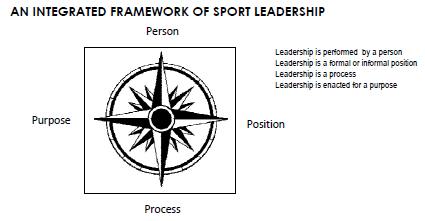
Embedded in the seven assumptions above are the four P’s of team leadership. The framework highlights the integration of the four key domains of leadership. The framework answers the question What is Leadership? Leadership is a position, it is a process, and it is performed by a person for a purpose.

Too often leadership is narrowly defined exclusively as a person. Conceptually this leads us back to a focus on the leader, her traits and disposition. But leadership is more than the idiosyncratic actions taken by a chosen person. It is a process. A process is simply a
coordinated way of doing things. Can student‐athletes, including those that don’t possess the so‐called necessary traits, learn a process for doing leadership things? Of course they can.

Leadership is also a position. In The Academy for Sport Leadership’s way of doing things we suggest giving each student‐athlete a “role” to on‐board them into the leadership team building development process. You’ll see this later when I introduce you to my 8 Roles of Teamwork. A leader’s words and deeds provide purpose, a compelling vision of the future. Effective team leadership answers, for all team members, the questions, “why am I doing this?”

The four P’s, like the compass that they form, are only a tool for answering the question “What is leadership.” Each student‐athlete (and coach too) brings his or her own unique values, skills, experiences, and personality to the leader role; and each student‐athlete has his or her own personal way of making change happen. The compass is a simple model that represents the key domains of an effective leadership development program.

To find out more about and order Sport Leadership Books authored by Dr. Dobbs including Coaching for Leadership, click this link: The Academy for Sport Leadership Books


Filed Under: Leadership

Being a Leadership Educator for all Athletes

August 18, 2017 by

An Interview with Dr. Cory Dobbs, President of 

Q:  Why do you find it necessary to add the role of Leadership Educator to the practice of coaching?  Aren’t coaches already modeling leadership for their student-athletes?

A:  Let me explain by telling you a story.  I recently met with a “brand” name coach and his staff to discuss leadership education.  The coach is highly recognized as a top coach in his field.  I opened our conversation by asking him “Are you a world-class coach?”  He looked at me with an unassuming grin.  So I said “The world certainly sees you as a world-class coach.”  His staff chuckled but agreed.  “So let’s check that box,” I said.  “And,” I declared, “would you agree that coaching is teaching?”  He and his staff vigorously shook their heads to imply a definitive “yes.”

“Now,” I continued, “are you a world-class leader?”  Again, he looked at me with a humble smile.   I asked his staff for a thumbs up or thumbs down vote of agreement.  All thumbs were pointed upward.  “Check that box too” I announced.

“Okay,” I said as I headed towards my home territory.  “Are you a world-class leadership educator?”  The grin on his face slipped into a look of bewilderment.  “Well,” I said cunningly, “if you’re a world-class coach and a world-class leader shouldn’t you be a world-class leadership educator?”  Puzzled and disoriented, the brand name world-class coach didn’t quite know how to respond.  I continued, “How do you go about developing team leaders—or in my world team leadership?”  After uttering something he asked me to explain to him just what leadership education is and how one goes about becoming a leadership educator.

A leadership educator is no different than, let’s say, a professor of management—someone who teaches management.  A leadership educator teaches leadership.  However, this role seems a little strange for many coaches.  Few engage in a planned program and curriculum with the deliberate intention to build team leaders.   Rather, most simply leave it to the seemingly natural growth of the individual.  Oh, let’s not forget that a rigorous development program can be time consuming and emotionally demanding.

“Coach,” I said, “we can’t check that box can we?”  I then began to teach: “The role of leadership educator requires a different mindset, skill set and involves very different actions from the one’s you’ve been practicing for a lifetime.”  The coach quickly acknowledged that a huge gap exists between what he and his coaching staff are doing and what they could do to develop team leaders.  He then asked if I would work with him and his staff to develop their knowledge, skills, and abilities to be high-performing leadership educators.

Q:  A leader in every locker sounds a lot like “Everyone gets a trophy.”

A:  First, there’s a big difference between welfare and well-being.  When everyone gets a trophy it’s often like a government handout—it’s freely given, no strings attached (and just as likely not to have been well-thought through as it does have extraordinary potential as a long-term positive of participation if done right).  However, when a coach is concerned for the total well-being of her student-athletes, she is delighted to have everyone on the team maximize the experience; which includes learning how to lead.

In a recent workshop a coach asked me if the idea of a leader in every locker is like a trophy for everyone.  I held back, but then I injected my research and organizational framework into my response.  I let the coach know emphatically, it’s just the opposite.  I had to first help the coach see beyond her flawed mental model of leaders are born, the driving factor behind such thinking.

The notion of a born leader appeals to our belief in intelligence, charisma, and other personal traits as attributes necessary for leadership.  Most of us have been taught since childhood, at least implicitly, that we are either a leader or a follower—mostly followers as we can only have one class president.  This plays on an almost universal theme that some people must be given the role of telling us what to do; it fits with our sensibilities that we are better off by granting some people power and agency.

To be sure, my experience—countless number of workshops plus working alongside coaches—is that in most cases coaches are cynics when it comes to the idea that everyone has the ability to lead (though anticipating the critique of this claim I’m compelled to ensure I don’t imply all are equally motivated to learn to lead).  For those of us who do not want to simply dismiss people as not capable of learning to lead—especially those who’ve had few role models in their lives—the concept of leadership development is a significant step forward.

The idea that leaders are extraordinary people with special gifts is an assumption many coaches have embedded in their minds—baked into the cake.  Most coaches operate from a paradigm—a set of assumptions about how the world works—that makes it difficult to understand why the virtues of a leader in every locker far exceed the verifiable inefficiencies of the team captain model.

What I’m advocating is this: when a coach assumes the role of leadership educator, it is to teach leadership to all his or her student-athletes.  Why in the world would you not want to teach leadership to all of your players?   And why in the world would you not want your players to develop a leadership mindset, skill set, and act like a leader?

Beginning with the end in mind, when you deploy a leadership learning system you are creating a learning organization.  When coaches honor the need to personalize learning for each student-athlete, they then create a dynamic learning environment in which everyone is learning in action and by reflection.

However, if a coach doesn’t think it’s worth his or her time, then it’s likely they are acting from what Stanford professor Carol Dweck calls a “fixed mindset.”  A coach that acts from this perspective will do little to stimulate interest and commitment to personal leadership development of the student-athlete.  Such a mindset places little value in teaching leadership.  After all, they reason, either the athlete is a “natural” leader gifted with the “right stuff” or they’re not.  This thinking suggests only a few athletes on any team are capable of leading.  Such thinking makes no sense.

Leadership is not an all-or-nothing ability, something you either have or don’t have.  As a form of social interaction, leadership can be developed when student-athletes and coaches put in effort, time, and practice.

The reality is the student-athlete (and the coach too!) has to work hard to learn how to lead, to develop a set of skills and competencies that will serve as a foundation for lifelong learning of leadership and team building.  Leadership can be learned, indeed it must be learned.  The key is that it must be practiced in order to facilitate the growth and development of the student-athlete.  Without practice, which requires time, effort, and energy, all you have is a potential leader.

Finally, in my Coach’s Guidebook: A Leader in Every Locker I make clear that most student-athletes are raised in sport to simply follow the lead of the coach; thereby making the participant a passive recipient of leadership.  After years of going along to get along the young athlete develops the habit of passive followership.  This is one of the biggest challenges of change we face as leadership educators.

Should everyone get a trophy?  Probably not (save for another day the issue of participation and achievement).

Should everyone get an opportunity to learn about leadership and explore how to lead?  Yes!  And to do so requires great effort on the part of the student-athlete.  The athlete is not given anything but opportunity.   Are all leaders equal?  No!  Everyone has a different starting line, but all student-athletes can learn to lead at some level.

Q:
  In your workshops you urge, quite forcefully I might add, coaches to rethink their
thinking?

A:  I do this because every act of coaching rests on assumptions, generalizations, and get this—hypotheses.  That is, the coach’s mindset determines to a great extent how he operates.  It is very unlikely that a coach will change his or her ways of coaching until they look in the mirror and consider who they are and what they believe and why they believe what they believe.  Once they peel away the layers and recognize how deeply held beliefs and attitudes—such as only a few athletes are capable of leading—he or she can design a culture that maximizes the experience for everyone.

It’s a shame that many coaches are intimidated by the idea that embedded within every player is a potential leader.  There is great suspicion of how things will work if everyone is potentially a leader.  A common concern about a leader in every locker came up one day when I was talking with a group of coaches.  “How can you ask us to have all our student-athletes lead?” one coach said to me.  “Isn’t that opening Pandora ’s Box?”  Recall that when Pandora’s Box was opened, all the troubles of humanity flew out.  Is this how coaches imagine what might happen should everyone learn to lead and be given opportunities to lead?

I understand their concern.  They really have no reference point to relate the practice of teaching everyone leadership.  But when coaches and players learn for example, the 5 Steps of Team Leadership, the 8 Roles of Team Leadership, and The Coach as a Leadership Educator that I’ve created it all begins to make sense.  Something else we do is utilize a specialized vocabulary.  In addition to the 5 Steps of Leadership our program includes specialized terminology and unique constructs such as the eight roles of team leadership, leadership educator, followership and leadership orientation, and leadershift to cite some of the vital elements of our way of talking, thinking, and developing leaders.

The unnatural gap between the traditional team captain model and the reality that everyone can learn to lead at some level requires a monumental change program.  It’s going to take awhile, but over time coaches will discover new things about how it all works together to the advantage of the program and the players.

New to the Second Edition of Coaching for Leadership!

We are pleased to announce a new chapter to the second edition of the best-selling Coaching for Leadership. The chapter, The Big Shift: Unlock Your Team’s Potential by Creating Player-Led Teambuilding, connects the previous edition of this book to its origin, as well as to the future of team sports. The new chapter sets forth a practical and applicable agenda for change and improvement. The reader is introduced to seven vital elements of change; seven shifts of traditional mental models that lead to the new core principles necessary for creating a player-led team culture. Click here for more information about Coaching for Leadership

About the Author

A former college coach, Cory’s coaching background includes experience at the NCAA DII, NJCAA, and high school levels of competition. While coaching, he researched and developed the transformative Becoming a Team Leader program for student-athletes. Cory has worked with professional athletes, collegiate athletic programs and high schools teaching leadership as a part of the sports experience and education process. Cory cut his teeth as a corporate leader with Fortune 500 member, The Dial Corp. As a consultant and trainer Dr. Dobbs has worked with such organizations as American Express, Honeywell, and Avnet.

Cory has taught a variety of courses on leadership and change for the following universities:

Northern Arizona University (Graduate Schools of Business and Education)

Ohio University (Graduate School of Education / Management and Leadership in Sport)

Grand Canyon University (Sports Marketing and Sports Management in the Colangelo School of Sports Business)

Visit www.corydobbs.com to read Cory’s leadership blog.


Filed Under: Leadership

  • « Previous Page
  • 1
  • …
  • 5
  • 6
  • 7
  • 8
  • 9
  • …
  • 12
  • Next Page »
  • Team Building
  • Mental Skills
  • Leadership
  • Practice Planning
  • Sports Performance
  • Systems
  • Drills
  • Archives

© Copyright 2026 Athletic Performance Toolbox

Design by BuzzworthyBasketballMarketing.com

Privacy Policy